Mirrors, veils and crumbling stone
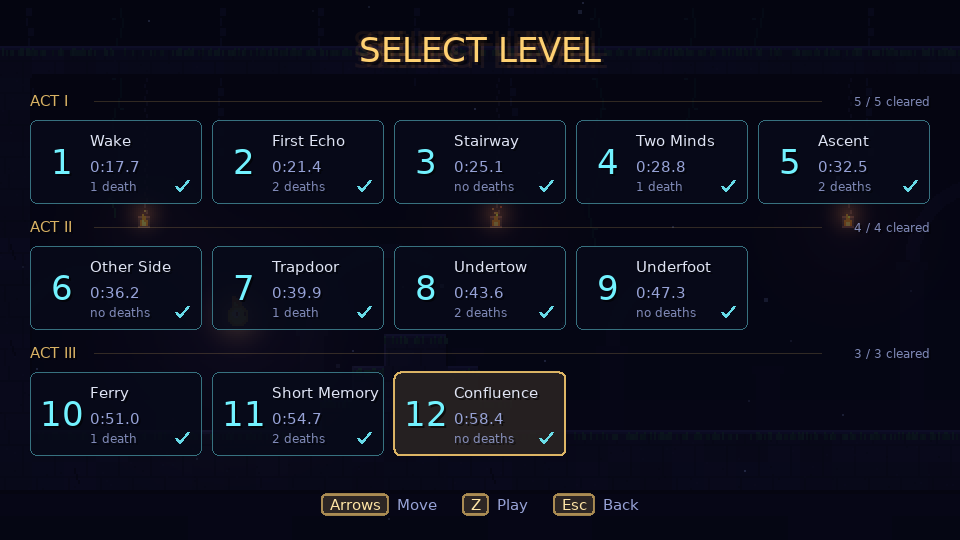
Five levels teach the echo without asking much of it. Harder puzzles needed the echo to do something new, so this round added three tiles that each change one thing about a ghost, and seven levels built on them. The game grew to twelve levels in three acts.
Three new tiles
The mirror shrine is violet. Cast while touching it and the recording is reflected about the shrine before it plays, so the ghost walks the mirror image of your path. That can put it on the far side of a wall you can’t get past.
The veil is amber. You walk straight through it, but an echo whose next pose would enter it stops at the edge and stays. It’s how you park a ghost exactly where you want it.
Crumble stone is ochre. It collapses half a second after anything stands on it and grows back once nothing is inside. An echo replays positions and has no physics, so a ghost keeps standing in the air where the stone was.
The registry from part 1 kept this cheap. First each tile’s interaction rectangle, and the world list it belongs to, moved into the table, so the level parser stopped special-casing plates and spikes. After that the three tiles were three new rows:
  plate = { plate = true, rect = { 1, 12, T - 2, 4 }, worldList = 'plates' },
  door = { solid = true, openable = true },
  mirror = { light = 56, mirror = true, worldList = 'mirrors' },
  veil = { light = 30, veil = true, rect = { 0, 0, T, T }, worldList = 'veils' },
  crumble = { solid = true, crumble = true, worldList = 'crumbles' },
They still needed a little code. The mirror is four lines that reflect every recorded frame about the shrine’s centre:
function Echo.mirror(frames, axis)
  for _, f in ipairs(frames) do
    f.x = 2 * axis - f.x - Echo.W
    f.facing = -f.facing
  end
end
Because the reflection happens to the copied frames at the moment of the cast, a mirrored ghost is an ordinary ghost from then on. It presses plates, carries you and stops at veils with no special cases. The echo’s mirrored flag is read only by the renderer, to pick violet over cyan.
The veil is a check in Echo:update. Before the ghost moves to its next recorded pose, the world asks whether that pose is inside a veil:
function Echo:update(dt, isBlockedAt)
  self.prevX, self.prevY = self.x, self.y
  if self.i < #self.frames and not self.halted then
    local n = self.frames[self.i + 1]
    if isBlockedAt and isBlockedAt(n.x, n.y, self.w, self.h) then
      self.halted = true
      slideToContact(self, isBlockedAt)
    else
      self.i = self.i + 1
    end
  end
  if self.halted or self.i >= #self.frames then
    self.lingerT = self.lingerT + dt
  end
  -- ...
A halted echo slides up to the veil’s edge, so it stops flush against it and not a few pixels short. It then starts the same 4-second linger as an echo whose replay ran out. To the rest of the game, a ghost at a veil is a ghost that has finished.
Seven levels
Act II brings in one tile per level. Act III combines them.
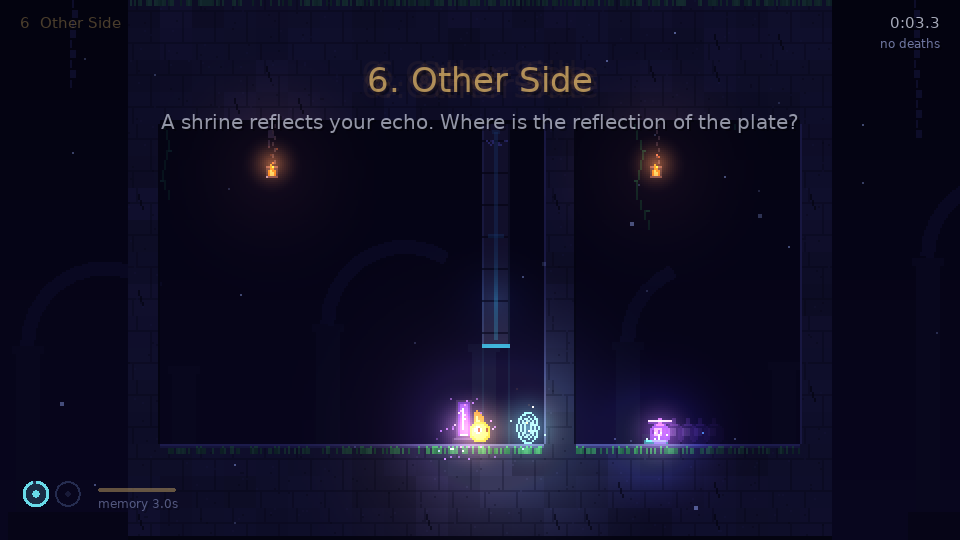
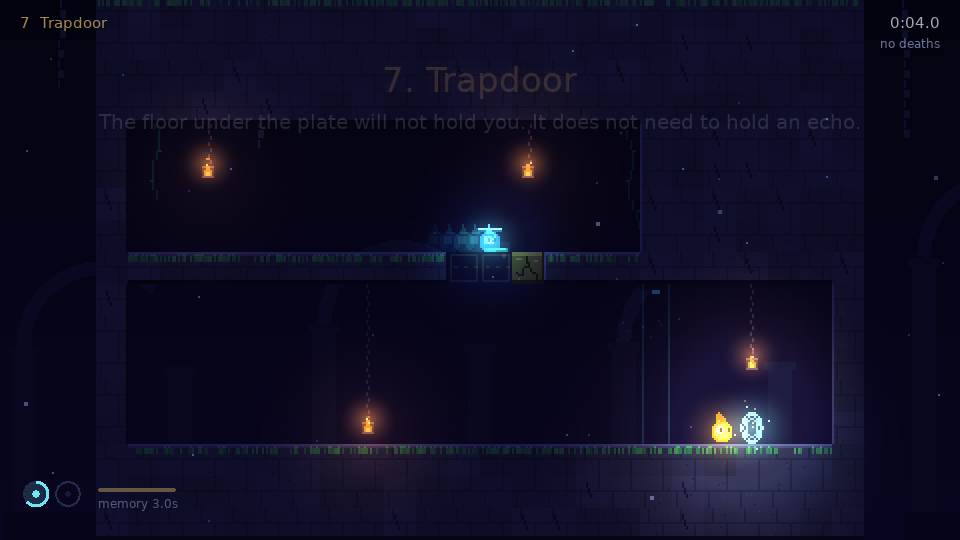
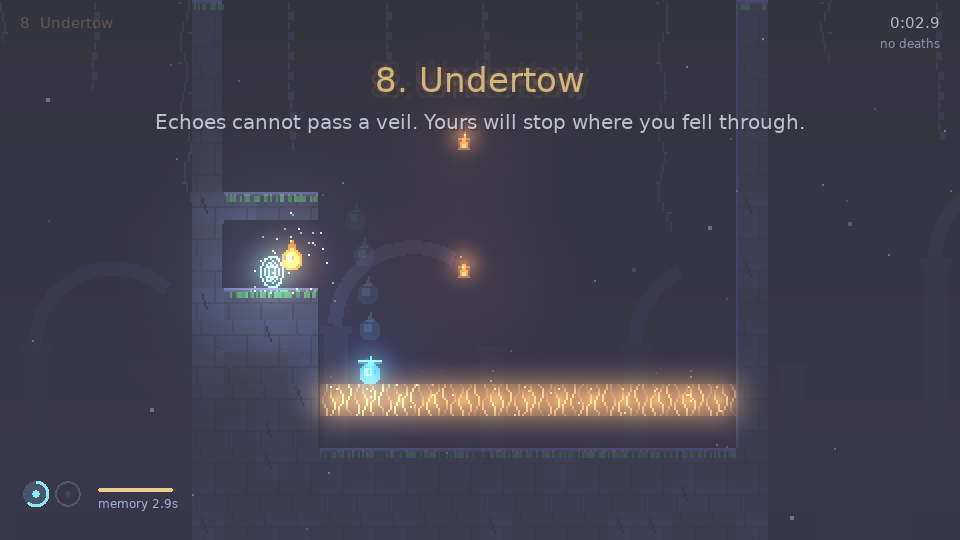
Each hint names a rule, not a move. Trapdoor’s reads “The floor under the plate will not hold you. It does not need to hold an echo.” Underfoot’s reads “A door is only a wall if you walk into it.”
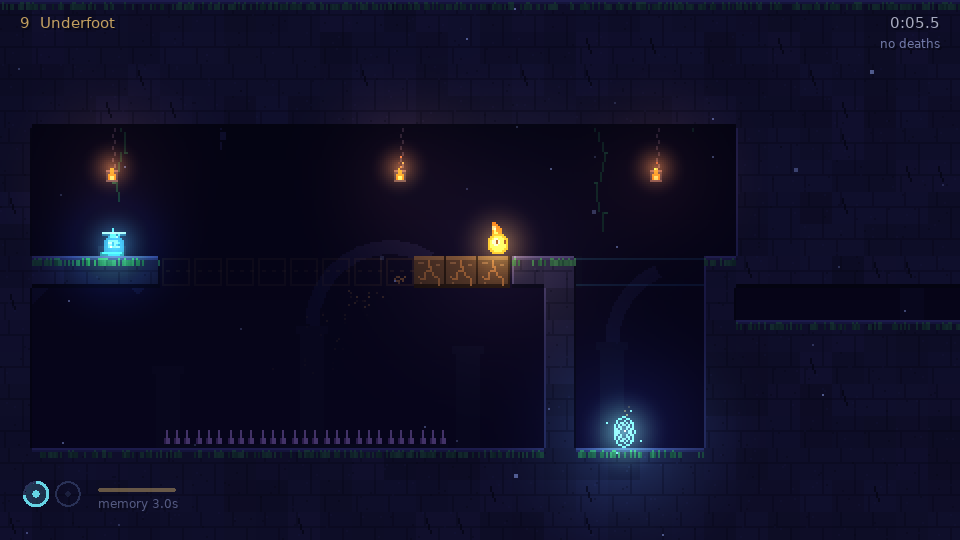
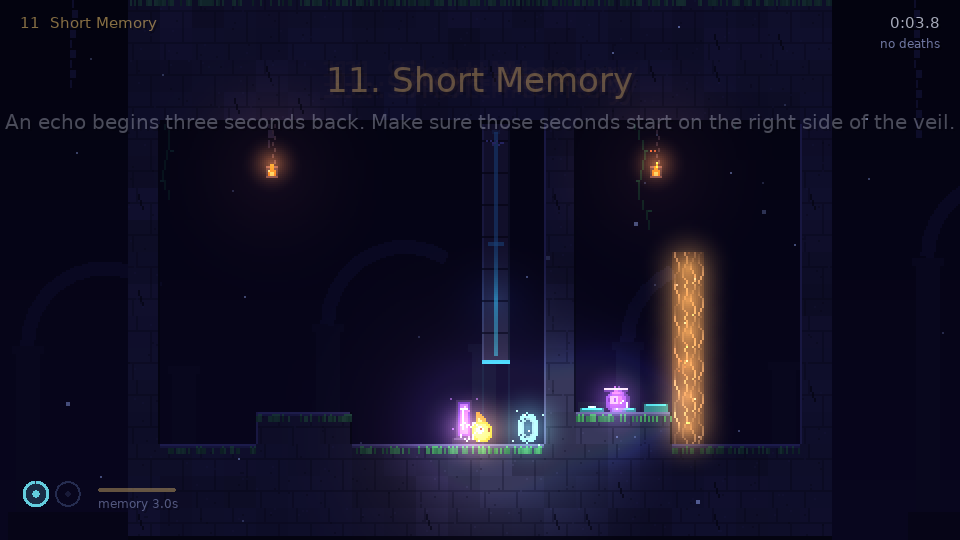
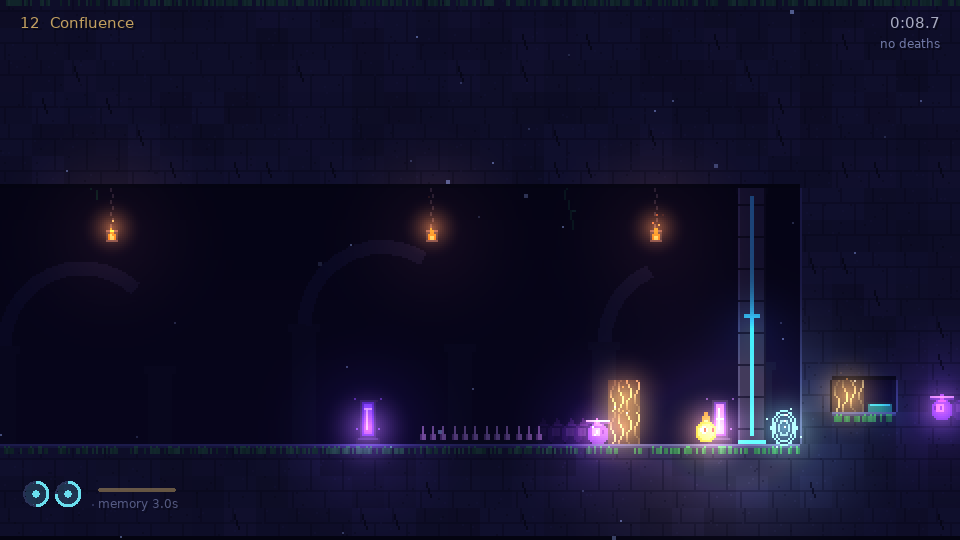
Level 10, Ferry, is missing here on purpose. It gets part 7 to itself, because it turned out to be much harder for a person than the checks said.
Checking that a level is a puzzle
A scripted solution shows a level can be beaten. It doesn’t show the level is a puzzle, or that a person can beat it. So besides clearing its solution, each new level got two more checks.
First, the naive approach has to fail. On Ferry a running jump has to land in the spikes. On Underfoot, walking to the hatch without an echo has to leave you standing on a closed door. If one of these ever passes, the level has a shortcut.
Second, the solution has to survive sloppy timing. The game reruns it with its timings shifted:
local VARIANTS = { { 3, 0 }, { -3, 0 }, { 0, 3 }, { 3, 3 }, { -3, 3 } }
The first number makes every fixed-length wait 3 frames shorter or longer. The second keeps each move going 3 frames past the moment its condition was met. All five variants have to clear the level.
That timing check was supposed to mean nobody would need frame-perfect play. It didn’t, and part 7 is about the level that showed it.