
Next: playtests and cleanup
Echoes now has 22 levels in five acts, waystones in every long level, rewind, the echo trail, an ember in every level, menus, saved progress and controller support. Here’s what’s left.
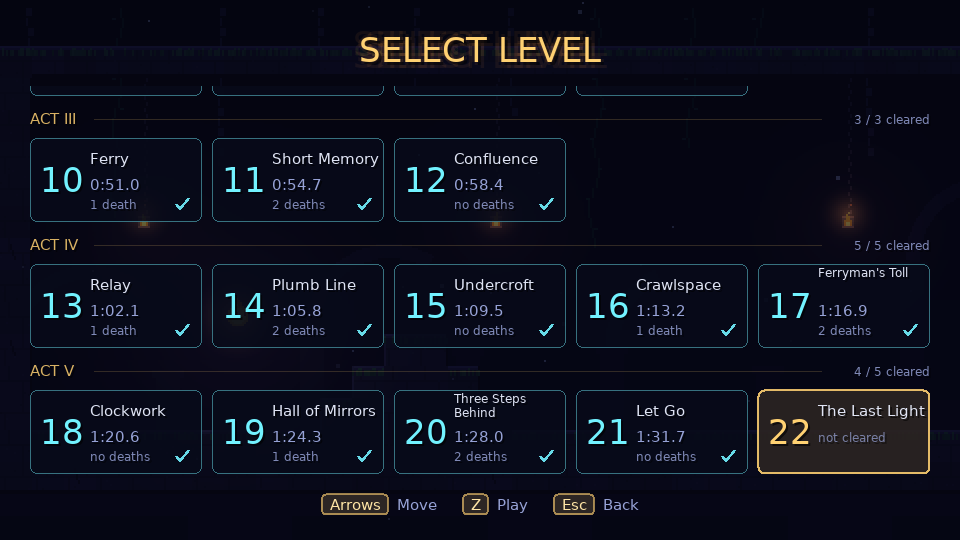
Put acts IV and V, rewind and embers in front of people
Every room in acts IV and V passes its solve, its naives, --slack and --cheese. None of those tools can say whether a person sees the insight from the waystone, or reads the hint and gets it. That takes playing each level with a pad, from the title, through every waystone, dying once per room on purpose. The real test is someone playing all ten levels cold while someone else watches where they get stuck.
The changes in part 12 need the same treatment. The questions are whether players find rewind from the death prompt alone, whether the trail helps them plan or just clutters the screen, and whether they notice embers and want them.
Close the known weak spots
Each of these is either a fix to try or a decision to confirm in the playtests:
- Let Go. A blind route that waits at the gate’s edge for the ghost on a to fade and walks straight through has a 24-frame window in every room, under the 30-frame bar. In rooms 2 and 3 the gate and exit door are 21 and 23 tiles from the waystone, past the first screen.
- Plumb Line. In The Well, a masher at the bottom wins with one cast 122 to 168 frames after landing. It’s accepted because The Well is the teach room and the winning ghost is the intended one.
- Ferryman’s Toll and The Last Light. The tap that steps onto the ferry has 7 frames on Ferryman’s Toll, with a declared need of 6. On both levels the need is justified the same way as level 10’s, because the ghost is only 10 px wide.
- Clockwork. The doors of the first room are three tiles beyond the first screen, so the player sees them only after three steps.
- Tight ember routes. The standing jumps for the embers in Other Side (16 to 20 px), Short Memory (12 to 16 px), Relay and Clockwork (about 20 px) are under the 24 px bar, and so is Ferry’s wall hop. They’re optional, but they should get
--slackstrategies or wider spots. - Underfoot’s ember is the weakest idea of the 22, and four act IV and V embers share one move, standing on your own ghost to reach higher.
Make one table describe each tile
Adding a tile still means editing five places, which adding the ember just did again. The waystone shows it. In game/world/level.lua, LEGEND maps w to the kind checkpoint:
['w'] = { kind = 'checkpoint' },
TILES holds its flags:
checkpoint = { light = 44, checkpoint = true, rect = { 3, 0, T - 6, T }, worldList = 'checkpoints' },
game/gfx/render.lua attaches its draw function, game/platform/assets.lua has a matching entry in SLOTS for drop-in art, and the comment at the top of game/content/levels.lua lists the map characters again. Miss one and the waystone works but has no art slot, or draws but isn’t in the legend comment a level builder reads.
The plan is one TILES entry per tile that also names its character, with LEGEND built from it and the render code finding each draw function by kind. The simulation still must not require anything from gfx/, so the draw functions stay in render.lua.
Split the two largest files by scene and by layer
game/screens/scenes.lua and game/gfx/render.lua are both over 800 lines, and both already show where they would split.
scenes.lua opens with code every scene shares: the camera that follows the player, the reaction to world events, and the ambient title hall behind the menus. After that come seven scenes, one table each: title, playing, pause, level select, settings, level clear, and ending. One file per scene would keep each one to a screen.
render.lua is already divided into sprite slots, tile drawing, level layer, backgrounds, actors, lighting, and frame plumbing. Tile drawing is the biggest section, about 360 lines, and it’s where the TILES draw functions attach and where the door drawing lives. Moving it into its own file fits with the single tile table above.
Make the headless rule fail loudly
Part 8 describes the rule that world/ requires nothing outside itself, which keeps the simulation free of drawing, sound and the clock. It still holds. The only two require lines in game/world point at world.player and world.echo. Today someone has to remember to check it. A check that reads the require lines in world/ and content/ would fail the first time someone breaks it.